Artificial intelligence is becoming increasingly integrated into business processes, but using AI tools does not necessarily mean that a company is undergoing transformation. On August 13, during the webinar “AI Maturity Framework: 6 Levels of AI-Driven Business Transformation,” participants examined a practical model for assessing a company’s AI maturity and looked at how AI can reshape not only individual productivity but also the way teams and entire organizations operate.
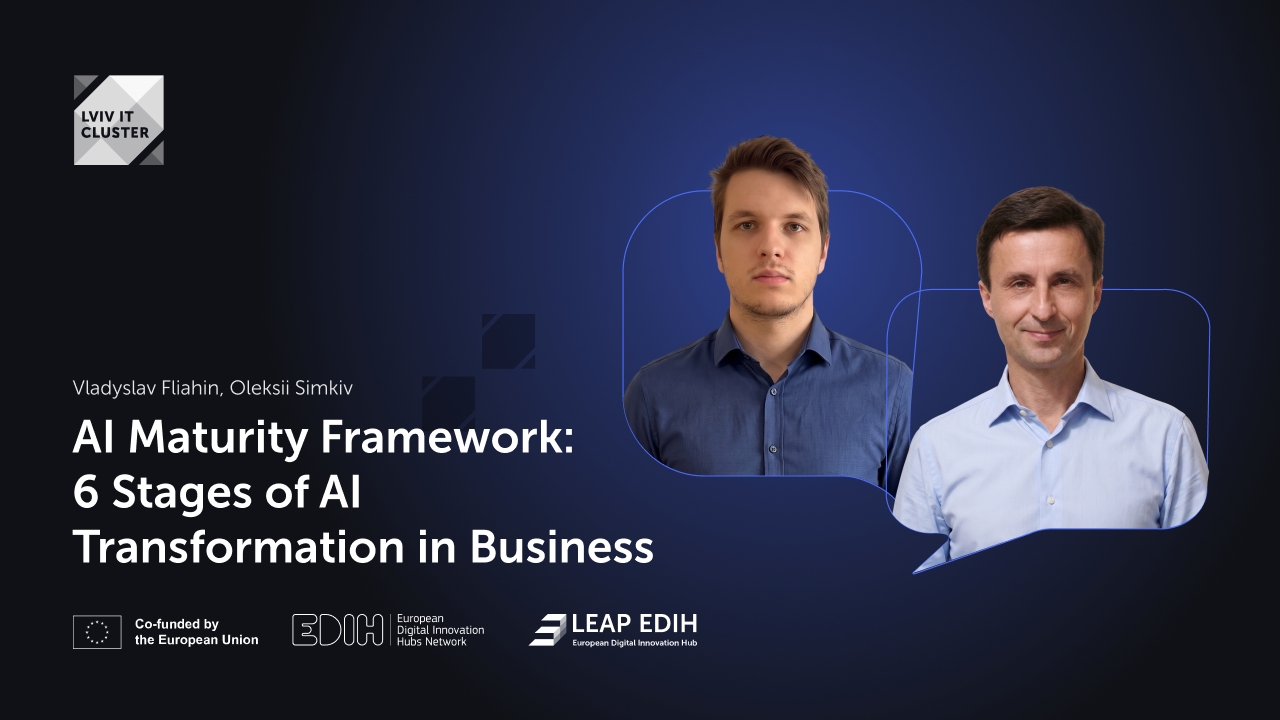
The session featured Vladyslav Fliahin, Lead Data Scientist, Co-founder of MindCraft AI, and author of the AI Maturity Framework, and Oleksii Simkiv, CTO, Co-founder of MindCraft AI, and an expert in AI audits and AI transformation roadmaps development.
The discussion highlighted that AI maturity is less about the level of adoption and more about how fundamentally AI has changed the way a company works. Individual AI solutions can increase employee productivity, but systemic transformation requires much broader changes. This includes how a business handles data, makes decisions, allocates responsibility, and translates knowledge into concrete actions.
During the webinar, the speakers presented four questions that can help quickly assess a company’s current stage of AI transformation:
These questions help companies understand the depth of transformation. As the speakers emphasized, one of the main limitations often lies at the very first stage: AI’s access to the information it needs. When a system cannot “see” the necessary context, its ability to act is limited.
The webinar also focused on the AI Maturity Framework, a model that describes six stages of AI maturity — from the initial use of individual AI tools to the development of autonomous systems capable of performing tasks and gradually improving their own performance.
“The challenge today is no longer that AI agents cannot perform complex tasks, but that people have not yet learned how to use their full potential. That is why it is important not only to implement these solutions, but also to know how to control their work, evaluate the results, and understand what is happening within the processes,” said Vladyslav Fliahin, Lead Data Scientist, Co-founder of MindCraft AI, and author of the AI Maturity Framework.
According to the speaker, expectations around the development of autonomous agents are evolving faster than anticipated. Systems can now perform complex tasks that previously required several hours of human work. For organizations, the challenge is shifting from adoption to readiness: knowing how to integrate these systems, evaluate their performance, and set boundaries for their autonomy.
AI transformation is not defined by the number of AI tools a company subscribes to, but by how fundamentally they reshape the way it operates. That is why it is important to assess how processes evolve, how knowledge is accumulated, and how decisions are made across the team.
Artificial intelligence is becoming increasingly integrated into business processes, but using AI tools does not necessarily mean that a company is undergoing transformation. On August 13, during the webinar “AI Maturity Framework: 6 Levels of AI-Driven Business Transformation,” participants examined a practical model for assessing a company’s AI maturity and looked at how AI can […]
https://itcluster.lviv.ua/wp-content/uploads/2026/08/youtube.png


