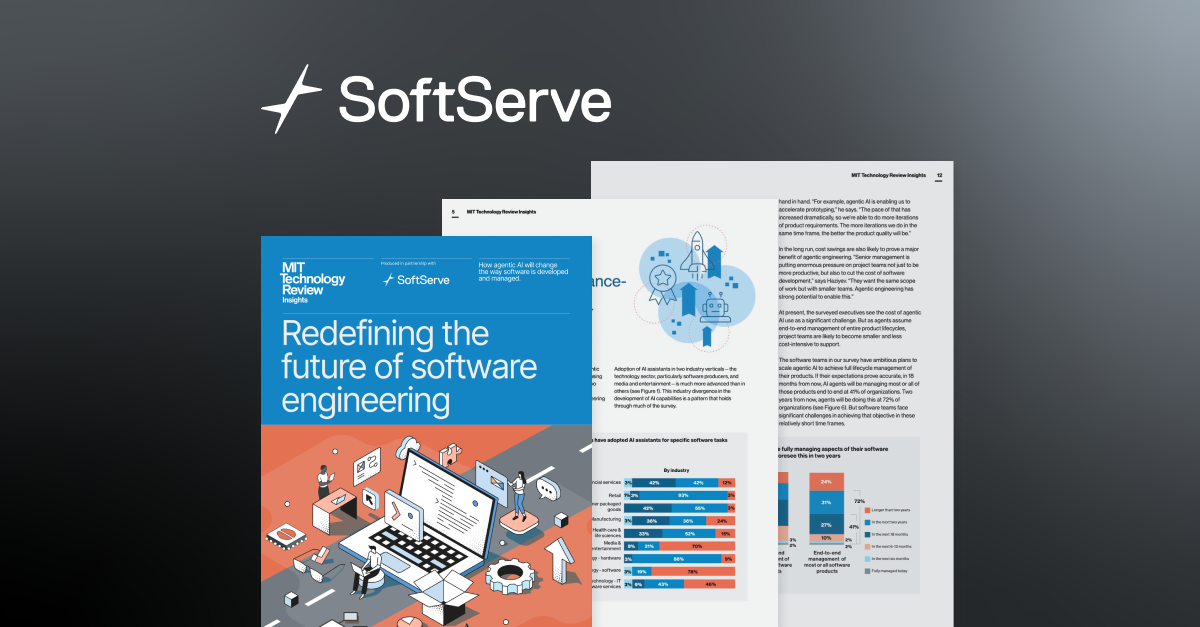
SoftServe, a digital engineering and technology services company specializing in AI, data, and cloud solutions, today released its new report, Redefining the Future of Software Engineering, which examines how agentic AI is changing the way software is designed, developed, and managed. Conducted by MIT Technology Review, the global study found nearly all respondents (98%) expect AI agents to accelerate software delivery.
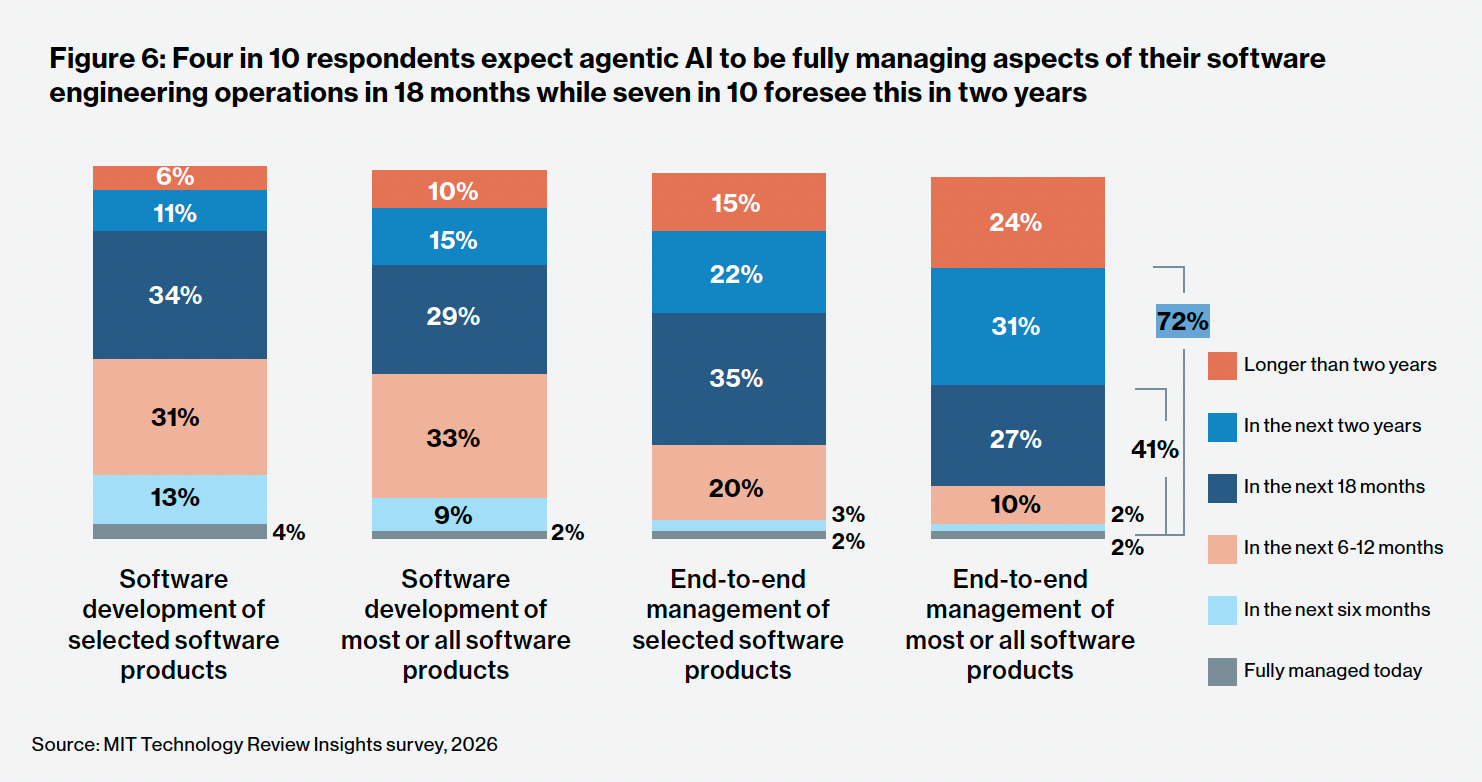
Software engineering teams are no strangers to agentic AI. The study found that 79% of respondents have been using tools such as AI assistants for the past two years, with coding and quality assurance cited as the greatest early benefits experienced in the first year at 44% and 38%, respectively. However, SoftServe’s report reveals the same teams are now advancing toward agentic engineering across the entire software development lifecycle (SDLC). In fact, 72% of organizations expect AI agents to manage most or all software or product lifecycles end‑to‑end within the next two years, with 41% predicting it will happen within 18 months.
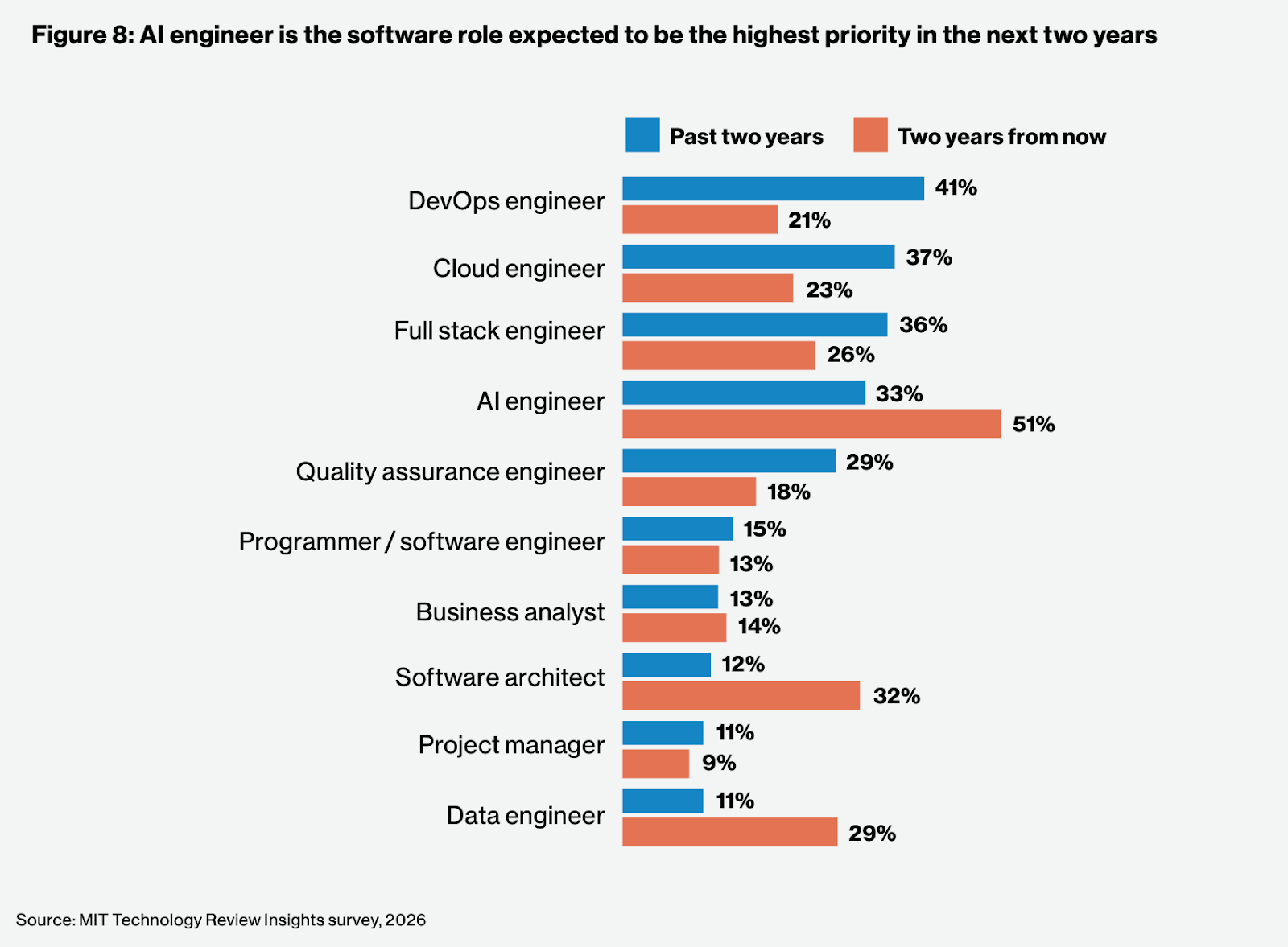
In software development, a shift in roles is expected — specialists will take on more responsibility for orchestrating agents, building multi-agent systems, and working with context, inputs, and agent instructions. While DevOps, cloud, and full-stack roles were previously the priority, AI engineers are now the most in-demand in the market, according to 51% of respondents. Demand is also set to grow for software architects (32%) and data engineers (29%). Overall, the findings point to a clear shift in the labor market: so-called “AI-native” professionals — experts across roles and disciplines with deep AI expertise — will be in the highest demand.
“How AI is used in software engineering continues to accelerate and evolve from individual vibe coding experiments to more disciplined agentic engineering, which has the potential to boost team productivity by an order of magnitude,” said Serge Haziyev, CTO, Advanced Technologies at SoftServe. “The implication is profound for the industry, but the technology alone will not deliver the promised leap. From our perspective, the turning — or tipping — point for the next era of software development will come not just from technology but completely rethinking the people, processes, and tools together.”
Overall, AI is not only about improving efficiency and reducing costs for businesses, but also about enabling the creation of better, higher-quality products. Survey respondents note that AI helps engineering teams to do the following:
The study also examines the perceived challenges organizations face with agentic AI in software engineering. While experts interviewed in the report point to change management as a major hurdle, only 12% of respondents identify it as a primary barrier to successful enterprise scaling. Instead, 44% cite computing costs and agent integration among the biggest challenges. This disconnect suggests organizations may be underestimating the difficulties of adoption and overestimating how quickly they can scale.
But experts believe that to be more effective, companies will need to make fundamental, ground-level changes across software engineering teams, core workflows, processes, and the SDLC. Ultimately, they say, the shift to agentic engineering will be worth it. While half of organizations deem agentic AI a top investment priority for software engineering today, it will be the leading investment for 84% by 2029.
Survey insights were drawn from 300 senior software engineering, data, and technology executives, including CIOs, CTOs, and CAIOs (Chief AI Officers). All respondents represent large enterprises across seven diverse industries and six countries. The vast majority generate $500 million or more in annual revenue, providing a clear depiction of how the world’s largest companies are deploying advanced AI tools.
To learn more about the forecasted future of software engineering and agentic AI, read the full report here on the website.
SoftServe, a digital engineering and technology services company specializing in AI, data, and cloud solutions, today released its new report, Redefining the Future of Software Engineering, which examines how agentic AI is changing the way software is designed, developed, and managed. Conducted by MIT Technology Review, the global study found nearly all respondents (98%) expect […]
https://itcluster.lviv.ua/wp-content/uploads/2026/04/softserve-x-mit-report-2.png


