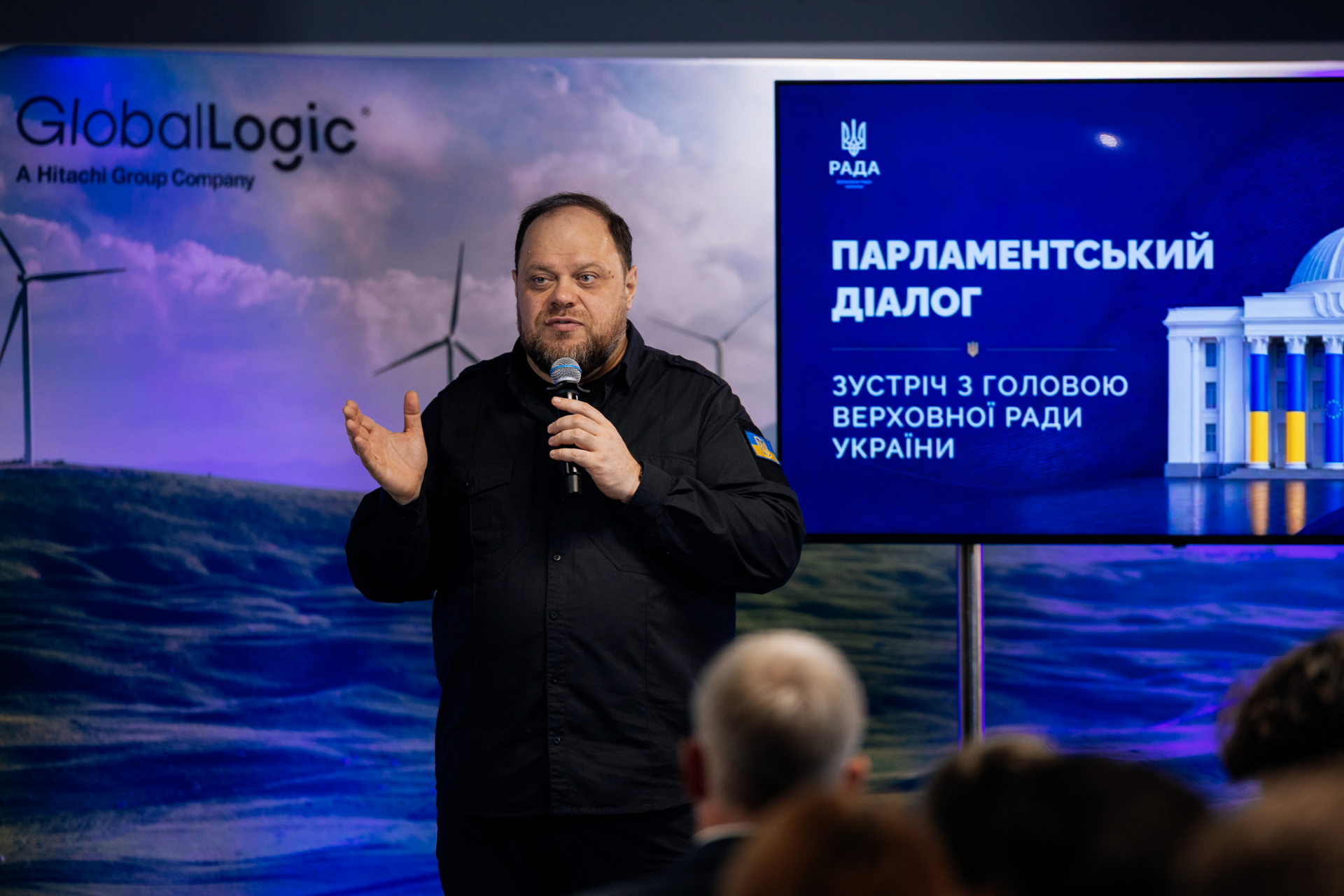
On October 7, Lviv IT Cluster and representatives of the technology sector took part in a Parliamentary Dialogue with Chairman of the Verkhovna Rada of Ukraine Ruslan Stefanchuk. The discussion focused on the draft of Ukraine’s new Civil Code, the digitalization of civil legislation, and the practical legislative challenges currently facing technology businesses.

Updating civil legislation is crucial for the technology sector, as the current Civil Code was adopted in 2003, before the large-scale development of the digital economy. Since then, a significant share of business, property, and personal relations has moved into the digital environment, while technology has become an integral part of the economy and everyday life.
During the meeting, Ruslan Stefanchuk presented the key approaches underpinning the draft of the new Code, while technology business representatives shared practical cases and issues that require legislative solutions. The participants also identified several areas that require further joint work between the government and the technology sector.
One of the key areas of the new Civil Code draft is adapting civil legislation to the digital reality.
In particular, it introduces the concept of digital identity. This approach is intended to regulate digital privacy, protection of information in the digital environment, digital reputation, and other human rights arising in the digital space. The discussion also covered protection against phishing, cyberattacks, and other digital threats, as well as protection from unwanted digital intrusion.
A separate section addresses digital objects. The proposed list of property rights would include digital assets, virtual assets, and accounts. The draft also provides for the inheritance of digital assets and other digital objects.
The participants also discussed electronic contracts. Under the proposed approach, electronic contracts would become a fully recognized form of civil transaction without the need to duplicate them in paper form, except in specific cases where a written form is necessary to protect a person’s rights and interests. The draft also expands the range of modern contract types that can be used in business and other economic activities.
Another important issue is the need for clear rules governing personal data and registers. The draft provides for the implementation of European approaches to personal data protection, including GDPR standards. Technology business representatives emphasized the importance of clear rules governing data storage, the operation of registers, and access to them.
One of the most important issues raised by the technology business was the codification and approval of software solutions used in the defense sector.
Company representatives noted that modern technologies on the battlefield rely heavily on software. At the same time, existing codification and approval procedures are largely built around physical products and their technical characteristics. As a result, software solutions or products in which software is a key component cannot always go through the existing procedures under the current framework. This creates practical barriers for companies developing technology solutions for the defense sector.
As a result of the discussion, technology business representatives will join efforts to address this issue and develop a clear mechanism for software solutions used in the defense sector.
The participants also discussed cooperation between technology businesses and government authorities in cases where existing procedures do not account for the specifics of new technology products. The next steps include separate working meetings with representatives of relevant government institutions to address specific business cases.
The discussion also covered a separate legal framework for artificial intelligence and results created with its use. At the same time, the participants specifically raised the issue of the legal status of software code and other intellectual works created without the use of AI.
In particular, the Chairman of the Verkhovna Rada invited views from tech industry representatives on how copyright protection should apply to human-authored code and other technological developments created independently of AI. This is a practical issue for the technology business that requires clear rules, as the development of generative AI is changing approaches to creating software products and other digital content.
The draft also includes specific provisions concerning military and IT developments in the defense sector, as well as stronger legal protection for know-how as a separate asset.
Technology business representatives also raised the issue of intellectual property rights to technology developments created in cooperation with military personnel.
This includes situations where service members participate in developing technology solutions or work on them outside their official duty hours. The participants emphasized the need to clearly define ownership and intellectual property rights to such developments and mechanisms for their protection.
Another practical challenge is the export of software solutions related to the defense sector. Company representatives noted that it is not always clear for businesses which procedures they should follow to obtain the necessary permits and which rules apply to the export of such products.
In response, Ruslan Stefanchuk noted that representatives of the relevant government institutions should be involved in addressing these issues in detail. In particular, the participants proposed a separate meeting with representatives of the Ministry of Defense of Ukraine and the Ministry of Digital Transformation of Ukraine to discuss specific cases faced by businesses.
The participants also discussed the dependence of certain government processes on foreign software and the need to develop Ukrainian alternatives.
As Ruslan Stefanchuk noted, the first step should be to analyze which software solutions the government actually needs and define the relevant requirements. The next step would be to work with the technology sector to identify opportunities to develop these solutions in Ukraine and establish the legislative conditions necessary for their implementation.
This issue is particularly relevant to the defense sector, where Ukrainian companies are already developing software solutions. The participants noted that these products could not only meet Ukraine’s domestic needs but potentially be scaled and brought to international markets.
This approach is also linked to the broader issue of Ukraine’s technological and economic independence. One of the objectives is to create conditions in which intellectual and digital products, patents, and licenses can account for a larger share of the country’s economic value.
Business representatives also discussed the relationship between the new Civil Code and procedural legislation. Changes to substantive law should be accompanied by corresponding changes to court procedures and the mechanisms for their application.
According to the Chairman of the Verkhovna Rada, the initial step is to establish new rules of substantive civil law, followed by work on the relevant changes to procedural legislation. This includes civil proceedings, non-contentious proceedings, and procedures for establishing legal facts. The reform of civil legislation is therefore viewed as a comprehensive process aimed not only at changing individual provisions but at reshaping the overall framework of private law.
Technology business representatives proposed addressing individual practical issues progressively rather than waiting for work on the entire Civil Code to be completed. This would involve identifying a problem, developing a potential solution, receiving feedback from businesses, and introducing the necessary changes where possible.
The team working on the draft Code noted that many of the issues are interconnected, meaning that isolated amendments may not address them systematically. Work on the draft has already demonstrated the interdependence of provisions concerning property, obligations, contracts, and other areas of civil law. Therefore, rather than focusing solely on individual amendments, the team proposes updating the overall framework of civil legislation and bringing it closer to European approaches.
At the same time, this does not exclude business participation in the process. As the Chairman of the Verkhovna Rada emphasized, representatives of the technology sector will be able to test the proposed provisions against real-life business cases and provide feedback before they are finally adopted.
Following the meeting, the participants agreed to continue communication between the Verkhovna Rada team and legal and technology experts from Lviv IT Cluster member companies. The next steps include systematizing the issues and proposals raised by businesses, establishing a working group, and holding dedicated working meetings with relevant government institutions.
On October 7, Lviv IT Cluster and representatives of the technology sector took part in a Parliamentary Dialogue with Chairman of the Verkhovna Rada of Ukraine Ruslan Stefanchuk. The discussion focused on the draft of Ukraine’s new Civil Code, the digitalization of civil legislation, and the practical legislative challenges currently facing technology businesses. Updating civil […]
https://itcluster.lviv.ua/wp-content/uploads/2026/10/6d6a5325-2-scaled.png


